In the same way that the Rhombic
Enneacontahedron can be generated as the vertex
zonohedron of the dodecahedron, further examples of convex rhombic
polyhedra with high degrees of symmetry can be generated as vertex
zonohedra of certain Archimedean polyhedra. As the polyhedra on this
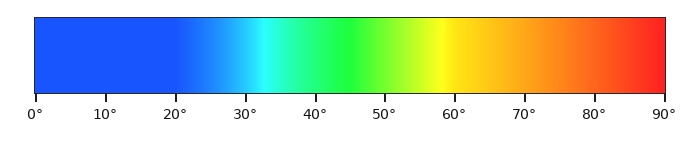
page get more complex, they have more types of rhombi. A colour
gradient has been used with narrow rhombi (acute angles <= 20°)
coloured blue and ranging through green and yellow towards nearly square
faces in red.
The general concept of zonohedra was set out by Fedorov (1885) [1]
. The 132-faced cases were first described by Hanegraaf (1980) [2]
and the Type C and Type T notationformalised by Watanabe & Betsumiya
(1984) [3]
The 552 faced case appreared as a model in Coxeter (1948) [4]
without any metrics. Hanegraf (1980) analysed and classified
it.
George Hart (1990) [5] included all the models on this
page in his zonohedrification
gallery.
This is occasionally called the rhombic hectotriadiohedron or the rhombhectotriadiohedron, but here I will use the prefix R132. In all cases the zonohedron has 12 zones giving the 132 = 12 x 11 faces.
There are two variants of the R132 which have only three types of rhombi:

Above is 'R132T' (also known as 'type T') the vertex zonohedron of the rhombicuboctahedron. It has Oh symmetry and three distinct types of rhombi with acute angles of 41.88°, 60.72° and 82.66°. Again they lie in 5 distinct symmetry orbits. It is topologically distinct from R132C as can be seen from the presence of valence 8 vertices,
A search of the zonohedra that can be generated from any point with in the (2,3,4) Wythoff triangle produced 5 combinatorially distinct 132-faced zonohedra. The other three examples have 4 or 5 types of rhombi.

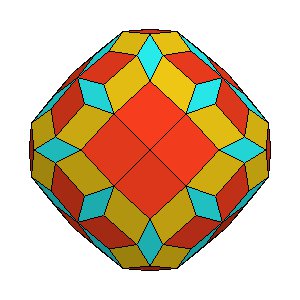
Above is the vertex
zonohedron of the great rhombicuboctahedron. The zonohedron
has 24 zones giving the 552 = 24 x 23 faces. There are 12 distinct
types of rhombi with acute angles ranging from 24.92° to 87.33° lying in
16 distinct symmetry orbits.
A search of the zonohedra that can be generated from any point with in the (2,3,4) Wythoff triangle produced 13 combinatorially distinct 552-faced zonohedra.
Three variations can be generated as zonohedra of Archimedean polyhedra. All are combinatorially distinct. Each has 30 zones giving the 870 = 30 x 29 faces.
A search of the zonohedra that can be generated from any point with in the (2,3,5) Wythoff triangle produced 14 combinatorially distinct 870-faced zonohedra.
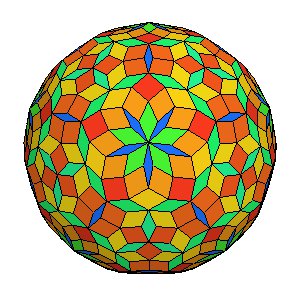
Above is the '870-ti'. It is the vertex
zonohedron of the truncated icosahedron. There are 10
distinct types of rhombi with acute angles ranging from 23.28° to 86.22°
lying in 11 distinct symmetry orbits.

Above is the '870-tid'. It is the vertex
zonohedron of the truncated dodecahedron. There are 9 distinct
types of rhombi with acute angles ranging from 19.39° to 89.00° lying in
11 distinct symmetry orbits.
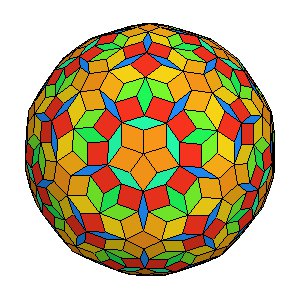
Above is the '870-srid'. It is the vertex
zonohedron of the rhombicosidodecahedron. There are 8 distinct
types of rhombi with acute angles ranging from 25.88° to 87.13° lying in
11 distinct symmetry orbits.
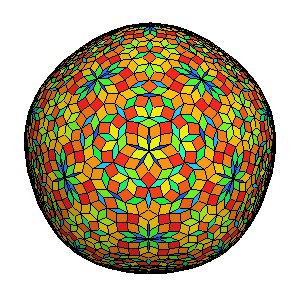
Above is the vertex zonohedron of the great icosidodecahedron. The zonohedron has 60 zones giving the 3540 = 60 x 59 faces. There are 30 distinct types of rhombi with acute angles ranging from 15.11° to 89.01° lying in 37 distinct symmetry orbits.
A search of the zonohedra that can be generated from any point with in the (2,3,5) Wythoff triangle produced 714 combinatorially distinct 3540-faced zonohedra.
1. Fedorov, E. S. (1885). Nachala
ucheniya o figurakh [Elements of the theory of figures]. Imperial
Academy of Sciences.
2. Hanegraaf, A. (1980). Twenty questions on zonogons, zonohedra and
zonoids. Structural
Topology, (4), 31–40.
3. Watanabe, Y., & Betsumiya, T. (1994). Derivation of some
equilateral zonohedra and star zonohedra. In R. Takaki (Ed.), Research
of pattern formation: Proceedings and research articles (pp.
55–62). KTK Scientific Publishers.
4. Coxeter, H. S. M. (1948). Regular
polytopes. Methuen.
5.
Hart, G. W. (n.d.). Zonohedrification.
Retrieved November 26, 2026, from https://www.georgehart.com/zonohedra/zonohedrification.html
Back: to Rhombihedra
Back: to index.