Geometric background for the interactive Wythoff Zonohedra
Explorer: how symmetry generates zone vectors, why coplanarity walls
divide the fundamental triangle into regions, and how faces merge when
zones lie in a plane.
1. Zonohedra as Minkowski Sums of Zone Vectors
Start with n distinct unit-length direction vectors
z1, …, zn in 3D space
(counting each axis once by treating opposite vectors +z and −z as the same direction). The resulting unit-edge
zonohedronZ is the Minkowski sum of the centred line segments
[−½zk, +½zk]:
Z = { ∑k=1..ntkzk : −½ ≤ tk ≤ +½ }
Each pair of distinct zone vectors {zi, zj} defines two opposite face normals
±w = ±(zi × zj) / ||zi × zj||.
When no three zone vectors lie in the same plane, every pair produces two opposite rhombic faces, giving:
Face / Edge / Vertex counts:F = n(n − 1), E = 2n(n − 1), V = n(n − 1) + 2.
Exact volume:Vol(Z) = ∑1≤i<j<k≤n |det(zi, zj, zk)| (valid even when coplanar triples contribute zero).
Parameterisation p(u, v) = (1, u + v, v) over u, v ≥ 0, u + v ≤ 1.
2. Fundamental Triangle and Symmetry Orbits
Rather than choosing n zone directions independently, we pick a single starting direction
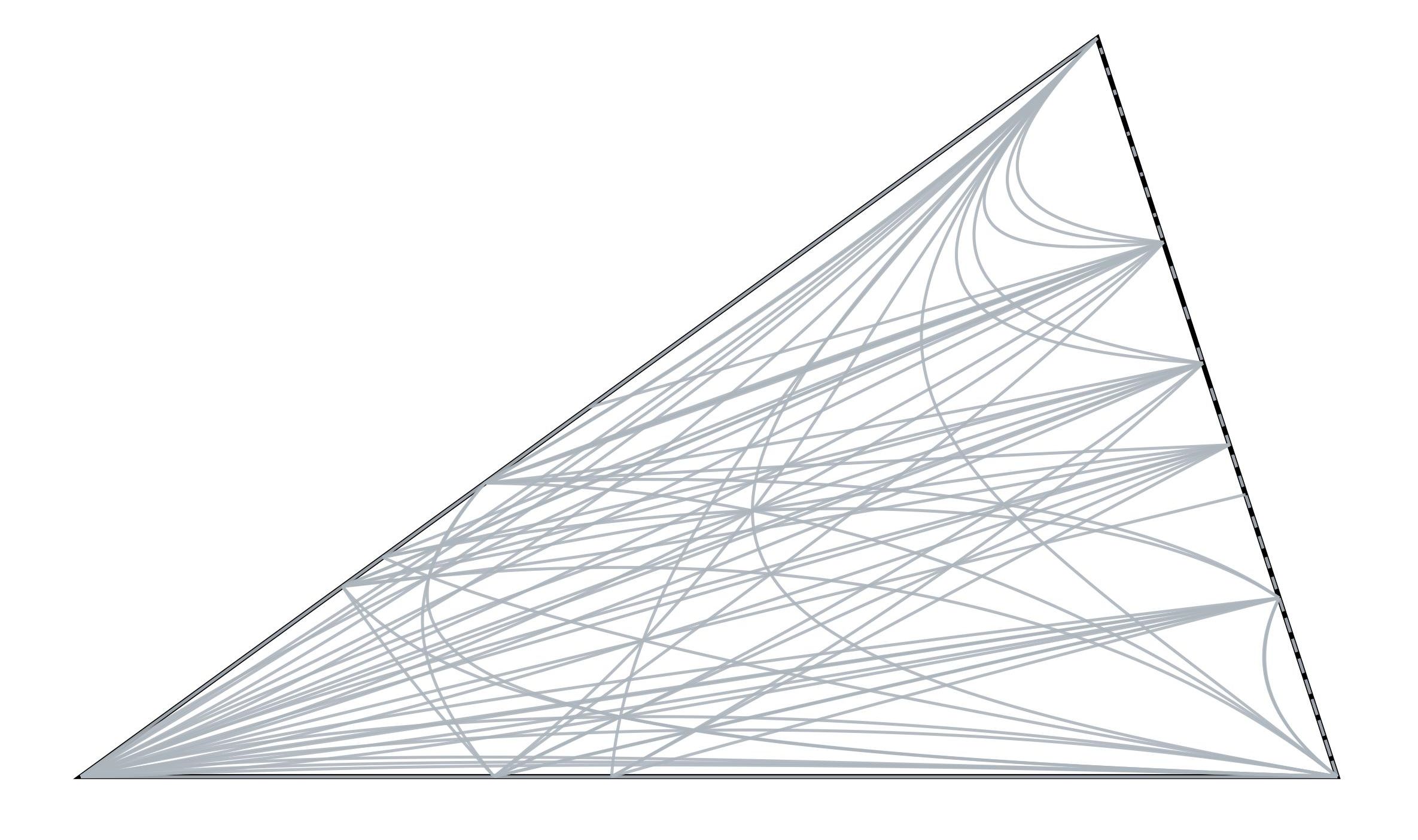
p(u, v) inside the (2,3,4) triangle
(x ≥ y ≥ z ≥ 0) and apply all symmetries of the group
G. Normalising the resulting directions to unit length and keeping one direction per ± axis gives the zone set.
Triangle
Symmetry Group
Group Order
Generic Zones (n)
Generic Rhombic V-E-F
Notes
(2,3,4)
Full Octahedral (B3 / Oh)
48
24
554-1104-552
All signed coordinate permutations; V4V2V3 is a true fundamental domain.
(2,3,4)P
Pyritohedral (Th)
24
12
134-264-132
Signed cyclic permutations only (lacks diagonal mirrors x=y, y=z, x=z); evaluated over the same V4V2V3 domain for direct comparison.
3. Coplanarity Walls, Chambers, and Merged Polygon Faces
Because symmetry treats all zone directions alike, three zones lie in a common plane whenever
det(v1(u, v), vj(u, v), vk(u, v)) = 0.
For both (2,3,4) and (2,3,4)P, these conditions reduce to polynomials of degree
≤ 3 in (u, v) that factor into lines, conics, and cubic curves (coplanarity walls) crossing the triangle. A more detailed description of this process is available here.
2D Interior Chambers: The walls divide the triangle into open regions (“chambers”), each defined by which side of every wall it sits on.
Inside a single chamber, moving (u, v)
stretches the rhombus angles continuously without changing how the
faces connect; crossing a wall flips how zones overlap and switches the
polyhedron to a different topological type. The explorer tints each
chamber distinctly and mirrors that hue onto the 3D background.
1D Boundary Edges & Walls: Along the triangle edges (u = 0, v = 0, u + v = 1), mirror-image zone vectors coincide and merge, halving the zone count (e.g., 24 → 12 in (2,3,4)). Along interior walls, m ≥ 3 distinct zones become orthogonal to a shared normal w.
0D Vertices & Intersections: At the corners V4, V2, V3
and where walls cross, multiple mirrors or coplanarity conditions align
at once, collapsing the zone count to simpler classic polyhedra (such
as the cube, rhombic dodecahedron, or truncated octahedron).
Non-Rhombic Faces (Dark Magenta): Whenever m > 2 zones lie in a plane perpendicular to the same normal w (w · zk = 0), their separate rhombic pairs merge into a single pair of opposite 2m-sided faces (hexagons for m = 3, octagons for m = 4, etc.). The explorer renders all faces with sides ≠ 4 in dark magenta so coplanar merges stand out in every colour mode.
4. Representative Examples
Select a configuration below to inspect how the chamber,
coplanarity walls, and boundary edges and corners alter the polyhedral
structure:
——
5. Explorer Controls and .off Export
Triangle Navigation & Snapping: Drag inside the triangle (or outside it to project perpendicularly onto the nearest boundary edge) to move p(u, v). Scroll the mouse wheel to zoom around the cursor (1× to 40×), right-drag or middle-drag to pan when zoomed, and double-click to reset zoom. When snapping is enabled, the pointer snaps to 0D intersections/vertices and 1D boundary edges or coplanarity walls (hold Shift to bypass snapping temporarily).
Equal-Angle Lines: When enabled, displays solid pink lines and conic curves where distinct rhombus symmetry orbits share the same acute angle, together with their intersection nodes, and includes them in 0D/1D snapping.
Zonohedron Viewport & Panel Divider: Drag to orbit and scroll the mouse wheel to zoom. Drag the splitter between the triangle and zonohedron panels horizontally (landscape) or vertically (portrait) to adjust panel proportions.
Colour Modes: Choose Colour: Rhombus Angle or Colour: Slate Blue. In angle mode, verified rhombi are coloured at full brightness by acute angle (≤20° blue, 45° green, 60° yellow, 90° red); faces with sides ≠ 4 remain dark magenta across all modes.
Metrics & Angle Breakdown: Live metrics report Zones (n), V / E / F, Face Types, Rhombus Types (distinct rhombus acute angles), Symmetry Orbits (face orbits under G), Volume, Surface Area, Angle Range, and Inradius / Circumradius. Click Angle Range to open a sorted table of rhombus acute angles, colour swatches, RGB/hex values, and face counts.
.off Export: Writes exact double-precision vertex coordinates formatted to 16 decimal places (values with |x| < 10−8 clamped to zero) and vertex-ordered face lists via the native file save dialog.
6. Results and Historical Context
The general theory of zonohedra was set out by Fedorov (1885) [1]. Selected 132-faced (12-zone) rhombic examples were first described by Hanegraaf (1980) [2], with the Type C and Type T notation formalised by Watanabe & Betsumiya (1994) [3], while the 552-faced (24-zone) case appeared as a model in Coxeter (1948) [4] without metrics and was analysed by Hanegraaf [2]; George Hart [5] also featured these vertex-zonohedron forms in his zonohedrification gallery.
Systematic chamber decomposition of the (2,3,4) and (2,3,4)P Wythoff triangles generates 5 combinatorially distinct 132-faced examples and 13 combinatorially distinct 552-faced examples. This constitutes the complete set of rhombic zonohedra with 12 or 24 zones and Th or Oh symmetry, which does not appear to have been previously catalogued in full.
The equivalent (2,3,5) icosahedral
triangle has also been explored exhaustively. Because of the algebraic
and chamber complexity of the 2D strata, a real-time interactive browser
version is not practicable for this; however, the full enumeration yields:
Fedorov, E. S. (1885). Nachala ucheniya o figurakh [Elements of the theory of figures]. Imperial Academy of Sciences.
Hanegraaf, A. (1980). Twenty questions on zonogons, zonohedra and zonoids. Structural Topology, (4), 31–40.
Watanabe, Y., & Betsumiya, T. (1994). Derivation of some equilateral zonohedra and star zonohedra. In R. Takaki (Ed.), Research of pattern formation: Proceedings and research articles (pp. 55–62). KTK Scientific Publishers.
Coxeter, H. S. M. (1948). Regular polytopes. Methuen.