Stewart Toroid realisations of the Szilassi Toroid and beyond ...


Stewart in 1980 showed that it is also
possible to colour
a number of Stewart Toroids to produce the
equivalent of the Szilassi toroid in that all
faces
of the same colour are contiguous and each of the seven colours is
contiguous
with the other six.
The image above is of the Stewart Toroid K3 / Q3T3
coloured in such a fashion.
On pages 200 and 201 of 'Adventures
Among the Toroids', Stewart presents, under 'Map Colouring
Problems', two interesting toroids closely related to this topic.
He presents edge adjacent colourings for genus 2 and genus 3 toroids,
but did not consider the possibility of planar representations.
It is interesting to see that the reduced face sets are
heterogenous.
"Map on a p=2 toroid
T5 /
2R5(D5)S5Q5
requiring eight colours" (
link to OFF
file). The reduced face set here consists of four 7-gons and
four
8-gons. There are two doubled edges in two independent
pairs of 8-gons and both have an edge distance of 2.
"Map on a p=3 toroid
K5 / 3R5(E5)S5Q5
requiring nine colours" (
link to OFF
file). The reduced face set here consists of three 8-gons and
six 9-gons. There are three doubled edges, in three
independent pairs of 9-gons and all have an edge
distance of 2.
This arrangement could be extended to toroids of genus 4 (two 9-gons
and eight 10-gons with four doubled edges) and genus 5 (one 10-gon and
ten 11-gons with five doubled edges). Whether any of these
would correspond to a
planar toroid is an open question.
The OFF files for the genus 2 and 3 cases above were generated from
stel files present on Alex Doskey's
site at www.doskey.com/polyhedra
(now sadly unavailable).
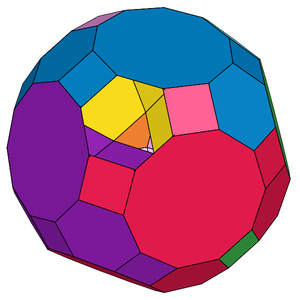
The Mizhaev genus 3 toroid

In attempting to produce an equivalent to Mizhaev's genus 3 toroid
(above), some further topological considerations had to be taken into
account.
1. Each 9-gonal face shares two distinct edges with two other
faces.
2. Traversing the faces through these doubled edges results in a
cycle which passes through all 8 faces.
3. For a pair of doubled edges, the polygons sharing that edge
each
have a specific number of edges between them (the 'edge distance').
Examination of the Mizhaev toroid reveals that the edge distances
around the cycle are as follows [2, 2/3, 2, 2/3, 2, 2/3, 2, 2/3]
where an entry of '2' means that both faces have an edge distance of 2,
an
entry of '2/3' means that one face has an edge distance of 2 and the
other face an edge distance of 3. The Mizhaev toroid could
then be described as Cycle: [8], Distances [2, 2/3, 2, 2/3, 2, 2/3, 2,
2/3], or in short form C[8] D[2, 2/3].
Using the Stewart Toroid K5 /
4J92(E5), I was able to generate a
colouring that precisely matched that of the Mizhaev toroid including
the edge distance cycle above. (link to OFF file).
From
the
net
of
the
Stewart Toroid I then generated an indexed face set
of eight enneagons by removing intermediate vertices where only two
colours are present and then reindexing. Analysis of this reduced
face set showed it to have a one-to-one correspondence (bijection) with
the face set of the Mizhaev Toroid.
The Röst-Vigh Genus 3 Toroid

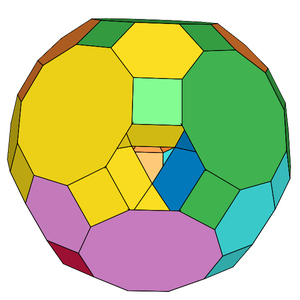
The equivalent description of the Röst-Vigh Genus 3 Toroid would be
Cycle: [4, 4], Distances [2, 2, 2, 2], [2, 2, 2, 2] or in short
form C[4, 4] D[2].
Again I was able to to generate a colouring that precisely matched
this using the same method as was described above for the Mizhaev
Toroid (link
to OFF file)
The Mizhaev Genus 8 toroid

This has 8 independent tunnels. No Stewart toroid is known with
more than six independent tunnels.
With each face having four collinear edges, which are not all shared
with a single other face, the cycle notation breaks down. There
appear to be three cycles of 4 and two cycles of 6 faces existing
simultaneously. All edge distances between collinear edges are 2.
Are there more examples?
It is also possible to generate a number of colourings of K5 /
4J92(E5) that meet the edge neighbourly
criterion but have different cycles and distance arrays from the
above. I have focused here on the more symmetric symbols as they
would result in more symmetric planar toroids. The list of cases
lists obtained is not complete but reflects a broad but non-exhaustive
search. See notation below for details of the
distance array strings:
- For the cycle [8] case C[8] D[2/3]
and C[8] D[3, 2/3] were generated along with other less regular
arrays.
- For the cycle [4,4] case C[4, 4] D[3] and C[4, 4] D[2, 3] were
among those that can be obtained.
- Solutions with a cycle of [3,5] can be obtained with various distance
arrays, none regular.
- If we allow faces to share three collinear edges they must
necessarily
form a cycle of 2. It was possible to form solutions of the form
C [2, 2, 2, 2] D[2] ; C [2, 2, 4] D[2] ; and C [2, 6] D[2],
- The only case where no candidates have been generated is cycle [2, 3,
3].
It was also possible to generate solutions where edge distances of 1
occurred. While these are possible in the Stewart Toroid
realisations these cannot be formed into toroids with planar faces as
the collinear edges and the one edge between them would form one
degenerate edge. This demonstrates that a solution to
the Stewart Toroid is not necessarily realisable as a planar toroid.
Dismissing the edge distance 1 examples, a total of 15
configurations have been generated to date in addition to the Mizhaev
and Röst-Vigh solutions. Whether some of these
other cycle arrays and distance length arrays can be realised as
toroids with planar faces remains an open question. As the
Mizhaev and Röst-Vigh toroids have only been discovered very recently
then perhaps there are more.
What about the genus 4 case?
The next toroid in this sequence would be an as yet undiscovered genus
4 toroid with nine 10-gonal faces and nine doubled edges.
For the genus 3 case, the two known solutions may be used as a guide
toward the expected symmetry of any further solutions. With
8 faces an octahedral/tetrahedral basis appears favoured with holes
making a
tetrahedral core with four openings. The four copies of J92
in the Stewart Toroid above were deliberately placed in a tetrahedral
symmetry to reflect this. It should be noted though that the
genus 1 Szilassi toroid only has C2 (cyclic 2) symmetry so the
discovery of two genus 3 cases with higher symmetries could be an
artefact of the search methods used.
The genus 4 case is less straight-forward. There is no guidance
from
known results. Nine faces does not give an obvious symmetry
beyond C3 (cyclic 3). If the holes lead to a central core then 5
of them are required. Two configurations were explored
1. K5 /
5J92(E5). (link
to
OFF
file) The overall symmetry was given
precedence. Three copies of J92 were placed in a C3 symmetry and
the remaining two at the poles, somewhat like the five faces of a
triangular
prism.
2. K5 /
5Q5S5(E5). (link to OFF file) A symmetric
arrangement of the holes was given
precedence. The five copies of Q5S5
were
placed
in
a
C5 (cyclic 5) symmetry.
A similar search was then conducted to the above, again excluding edge
distance 1 cases, the lists obtained are not complete but reflect a
broad but non-exhaustive search:
The case 1 run has resulted in more than 290 topologically distinct
candidates. The potentially symmetric cases are:
- C[9] D[2/3]
- C[3, 3, 3] D[2/3]
- C[3, 6] D[2] [2, 3]
Other interesting looking cases include:
-C[2, 7] D[2] ; C[2, 2, 5] D[2] and
C[2, 2, 2, 3] D[2].
- C[2, 3, 4] D[2] [3] [2, 3]
-C[9] D[28, 3]
-C[9] D[2, 2/38]
The case 2 run also resulted in more than 140 topologically distinct
candidates. As expected, there is no candidate topology showing
any high degree of symmetry, the most interesting looking being:
-- C[2, 3, 4] D[2] [3] [2, 3]
- C[3, 3, 3],D[3] [3, 2/3, 2/3] [3, 2/3, 2/3]
- C[3, 6] D[3] [2, 3, 2, 3, 2, 4]
- C[9] D[23, 2/36]
-C[9] D[2, 2/38] (again)
Whether the differing lists of cases obtained is a reflection of the
differing symmetries of the Johnson Solids, or whether it is merely an
artefact of incomplete lists is an open question. The difficulty
in generating case 2 examples in comparison to case 1 examples implies
the former.
Notation
Each face normally shares two doubled edges with two other faces.
Following the path of these doubled edges leads to cycles
of polygons. In some cases one cycle covers the entire
polyhedron. In other cases there is more than one distinct
cycle. The list of face cycles is denoted by C[X, Y, Z] where X,
Y and Z denote the cycle lengths. It is also possible for a
polygon to share three edges with one other, in which case the
cycle length in necessarily 2 given the class of polyhedra under
consideration.
Where two faces share a doubled edge, it becomes necessary to count the
number of edges in each polygon in between those edges. This is
termed the 'edge distance'. It need not have the same value for
the two polygons. The edge distance for each cycle is denoted by
the string D[L, M, N ...] where there is one entry for each polygon in
the cycle. Where the edge distance between the polygons is
different, this is denoted by P/Q where P and Q are the respective edge
distances (ordered such that P < Q). For cycles of
length 2, where the polygons have three common edges, the distance is
denoted by [M;N] where M is the edge distance between common edges one
and two, and N is the edge distance between common edges two and
three.
The edge distance strings are alwasys sequenced to their
lexigraphically lowest value without losing the cyclic
order.
For brevity, the edge distances can be shortened where this does not
introduce any uncertainty. D[2, 2, 2, 2] can be denoted as D[2]
as can D[2; 2]. D[2, 3, 2, 3] can be denoted as D[2, 3].
Further compression is possible if all edge distances are the same so
C[2, 4] D[2;2] [2, 2, 2, 2] can be compressed to C[2, 4] D[2] [2] and
further to C[2, 4] D[2].
Repeat values can be denoted with exponents D[2, 3, 3, 3] can be
represented as D[2, 33]. Notation such as D[2,
2/33] should be read as D[2, 2/3, 2/3, 2/3]. The C
arrays are generally short enough so as to not need compacting.
Back: To Toroids
Back:
To Index