Kepler-Poinsot Polyhedra

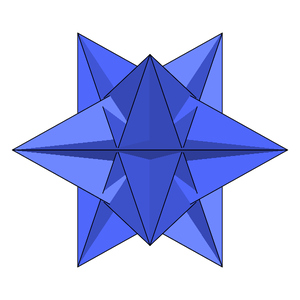
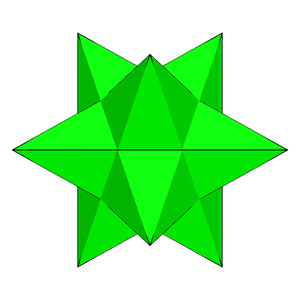
In 1619, Johannes Kepler discovered two regular star polyhedra: the small stellated dodecahedron and the great stellated dodecahedron. In 1809, Louis Poinsot discovered two more: the great dodecahedron and the great icosahedron. Together with the five Platonic solids, they complete the set of nine regular polyhedra.
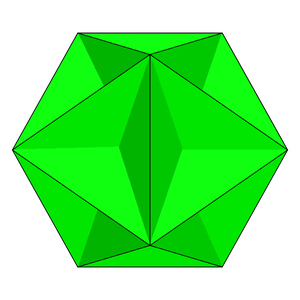
U34 Small Stellated Dodecahedron
34 - Small Stellated Dodecahedron
V: 12  |  E: 30  |  F: 12
Vertex Config: 5⁄2 · 5⁄2 · 5⁄2 · 5⁄2 · 5⁄2
Bowers: sissid  |  TOCID: D*
Wythoff: 5 | 2 5⁄2
Kaleido: K39  |  Wenninger: 20
U35 Great Dodecahedron
35 - Great Dodecahedron
V: 12  |  E: 30  |  F: 12
Vertex Config: (5 · 5 · 5 · 5 · 5)/2
Bowers: gad  |  TOCID: E
Wythoff: 5⁄2 | 2 5
Kaleido: K40  |  Wenninger: 21
U52 Great Stellated Dodecahedron
52 - Great Stellated Dodecahedron
V: 20  |  E: 30  |  F: 12
Vertex Config: 5⁄2 · 5⁄2 · 5⁄2
Bowers: gissid  |  TOCID: E*
Wythoff: 3 | 2 5⁄2
Kaleido: K57  |  Wenninger: 22
U53 Great Icosahedron
53 - Great Icosahedron
V: 12  |  E: 30  |  F: 20
Vertex Config: (3 · 3 · 3 · 3 · 3)/2
Bowers: gike  |  TOCID: J
Wythoff: 5⁄2 | 2 3
Kaleido: K58  |  Wenninger: 41