Triangulated Archimedean Polyhedra


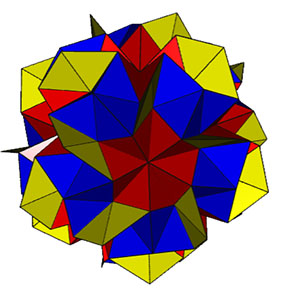
Triangulated Great Rhombicosidodecahedron
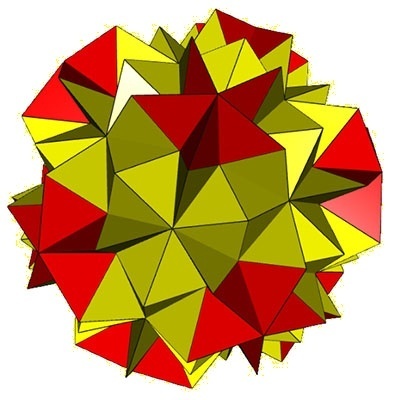
Level 2 Triangulated Truncated Icosahedron

On this page I explore the results of triangulating various regular polyhedra and relaxing the resulting figures until all triangles become equilateral.  Triangulation in this sense means dividing an n-gon (with n>3) into n congruent triangles all meeting at the centre.  I also explore the results of triangulation using 2n similar triangles for each n-gon.

My recent exploration of arruated polyhedra involved a step of placing pyramids on the faces of the Platonic and Archimedean polyhedra.  For the most part, this was a fairly trivial exercise as triangles, squares and pentagonal faces can be augmented with regular pyramids, and hexagons can be divided into six equilateral triangles, effectively a pyramid of height zero.  For the octagonal and decagonal faces, the triangular faces of pyramids have to be distorted, even for the zero height cases.  This led me to the question as to how valid it is to consider such an augmentation.  I decided to explore whether polyhedra augmented in such a manner could be relaxed such that the triangles become equilateral.  

There are four Archimedean polyhedra containing octagons or decagons. Where a triangulation has been successfully generated, the link is in the form (faces, edges, vertices)

Seed
Level 1 Triangulation
Truncated Cube
'tic' (8-8-3)
None found
Truncated Dodecahedron
'tid' (10-10-3)
None found 
Great Rhombicuboctahedron
'girco' (8-6-4)
(144,216,74) , Snub (120,180,62)
Great Rhombicosidodecahedron
'grid' (10-6-4)
(360,540,182) , Snub (300,450,152)

Triangular faces are not subdvided as (i) it is not necessary to triangulate a triangle, and (ii) the result of the subdivision would merely be to replace the triangles with tetrahedra, which would not result in any distortion of the original triangular face. 

For those seed polyhedra not containing triangles, each vertex of the seed polygon becomes a 3
6 vertex as there are two triangles from each adjoining face and all the above polyhedra have a valence of 3.  There are also 3n vertices at the centre of each n-gonal face of the seed.  See this example of a triangulated great rhombicosidodecahedron prior to relaxation.

The 'snub' links in the table above link to a variation where the square faces of the seed polyhedron have been split into two triangles rather than four.  In these cases the vertices of the seed polyhedron are split into two groups, one being 35 vertices and the other 36
See this example of a 'snub mode' triangulated great rhombicosidodecahedron prior to relaxation.


Level 2 triangulations

Rather than triangulate an n-gon into n congruent triangles it is possible to sub-divide each n-gon into 2n congruent triangles, all meeting at the centre.  Triangular faces in the seed polyhedra are now subdivided.  Vertices become 32v at the valence v vertices of the seed polyhedron, 32n at the cente of each n-gonal face, and 34 at the midpoint of each edge.  See this example of a
level 2 triangulated icosidodecahedron prior to relaxationNote that no attempt has been made to differentiate 'exo' and 'endo' modes (see arruated polyhedra), all cases below were generated with the triangles in the plane of the seed polygon.

Platonic and
Kepler-Poinsot Polyhedra

For the Platonic and Kepler-Poinsot seeds the result is an isohedral deltahedron.  The references given below are to Shepherd's 1999 paper on this subject [1] (with extensions marked
).  Note that a seed polyhedron and it's dual give the same result.

Seed
Level 2 triangulation
Tetrahedron
(24,36,14)
T1(3)
Octahedron, Cube
(48,72,26)
O2(2)
Icosahedron , Dodecahedron (120,180,62)
I1(2)
Great Icosahedron , Great Stellated Dodecahedron
(120,180,62)
I3(4)
Great Dodecahedron , Small Stellated Dodecahedron
(120,180,54)
I2(1)


Archimedian Polyhedra


For the Archimedian polyhedra the results are not isohedra, there is also no 'snub' equivalent.

Seed
Level 2 triangulation
Truncated Tetrahedron (72,108,38)
Truncated Octahedron
(144,216,74)
Truncated Cube
(144,216,74)
Truncated Icosahedron
(360,540,182)
Truncated Dodecahedron
(360,540,182)
Small Rhombicuboctahedron 'sirco'
(192,288,98) [Note 1]
Small Rhombicosidodecahedron 'srid'
(480,720,242)
Great Rhombicuboctahedron 'girco'
(288,432,146)
Great Rhombicosidodecahedron 'grid'
None found [Note 2]
Snub Cuboctahedron (240,360,122) [Note 1]
Snub Icosidodecahedron (600,900,302) [Note 1]

Note 1: The seed polyhedron had to be distorted before a triangulation could be obtained.  The seeds were augmented with pyramids (elongated if necessary), and the resulting triangular faces were subdivided into two similar triangles before the relaxation phase.  The distorted seeds are isomorphous to the original seeds.  As these have everted pyramids, they can be regarded as 'exo' modes.  Inverted pyramids can give rise to different isomorths (for example this 'endo' small rhombicuboctahedron triangulation).  Other isomorphs formed may also exist.

Note 2: It is somewhat puzzling that the great rhombicuboctahedron triangulation could be generated but not the equivalent
great rhombicosidodecahedron could not (even with a distorted seed)  This may be due to software limitations, but two independent programs (Great Stella and HEDRON) both failed to generate a triangulated polyhedron.  It remains a possibility though that a triangulation could be obtained from a suitably distorted seed.


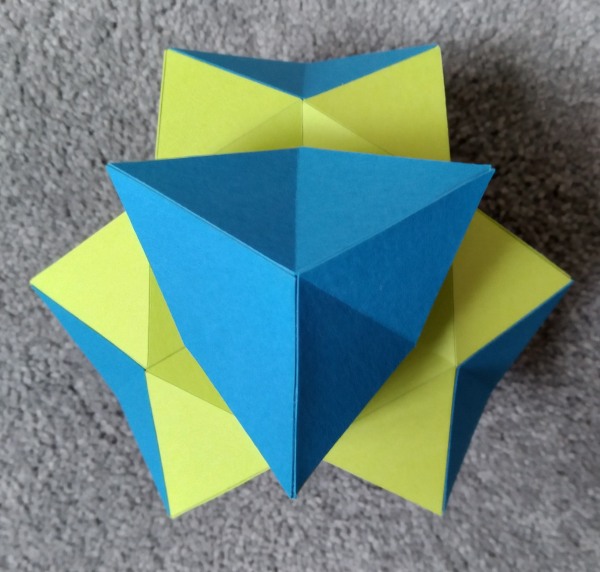
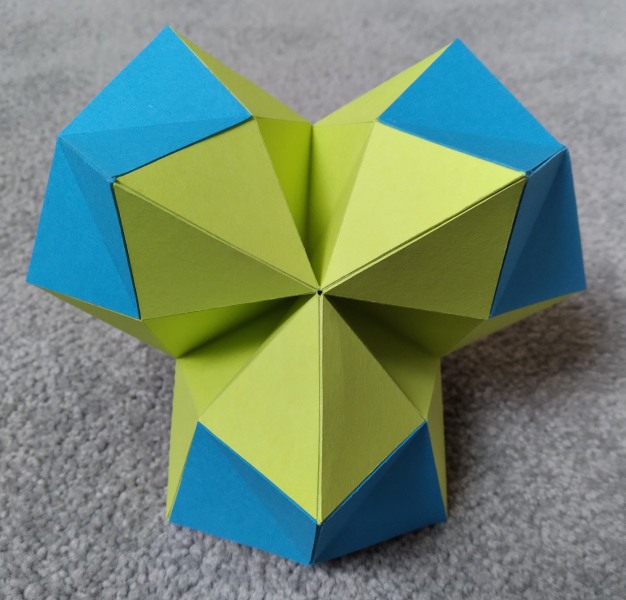
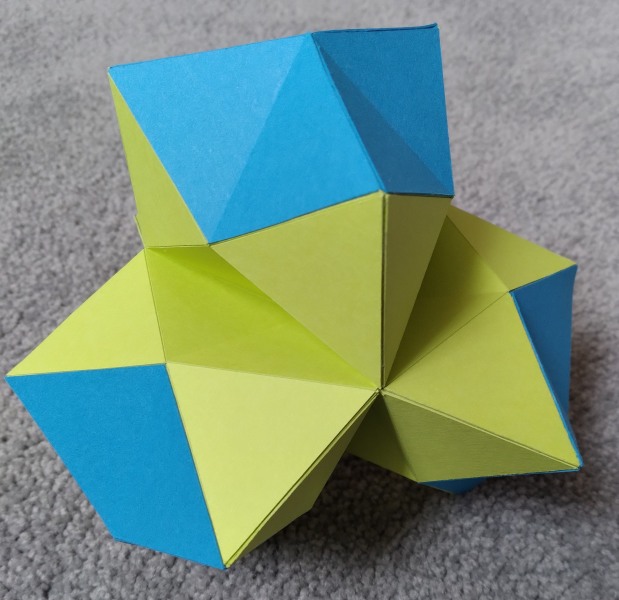
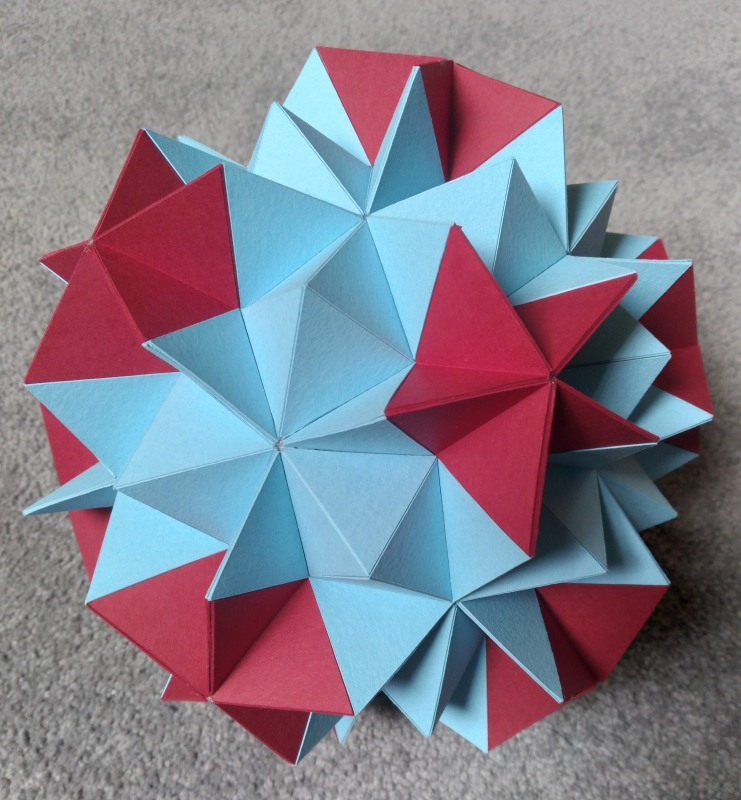
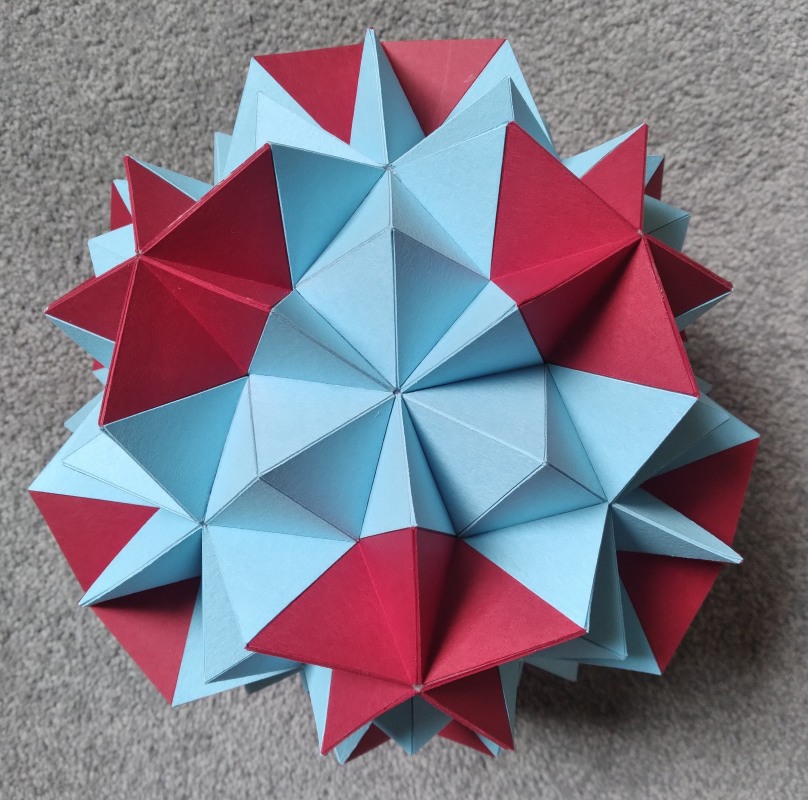
Don Romano has created a physical model of the level 2 triangulated truncated tetrahedron, truncated cube and truncated icosahedron.

Selected Uniform Polyehdra

Level-2 triangulations have also been generated for a selection of uniform polyhedra.  There does not appear to be any simple rule for which polyhedra will generate triangulations.  The list below is limited to those producing successful relaxations.  For the prisms, triangulation is possible only up to n=5.  For antiprisms, triangulation is always possible but the results are degenerate with multiple vertices coincident at the centre (example for n=7).  The bi-antiprism though does relax and has at least two isomorphs (iso1, iso2)

Seed
Level 2 triangulation
Triangular Prism
(36,54,20)
Pentagonal Prism
(60,90,32)
Dodecadodecahedron 'dod'
(240,360,114)
Great Icosidodecahedron 'gid'
(240,360,122)
Truncated Great Icosahedron 'tiggy'
(360,540,182)
Truncated Great Dodecahedron 'tigid' (360,540,174)
Small Ditrigonal Icosidodecahedron 'sidtid'
(240,360,112)
Great Ditrigonal Icosidodecahedron 'gidtid'
(240,360,112)
Ditrigonal Dodecadodecahedron 'ditdid' (240,360,112)
Small Quasi-Stellated Dodecahedron  'quitsissid'
(360,540,174)
Great Snub Icosidodecahedron  'gosid'
(600,900,302)
Great Inverted Snub Icosidodecahedron  'gisid' (600,900,302)
Great Snub Dodecicosidodecahedron  'gisdid' (720,1080,344)


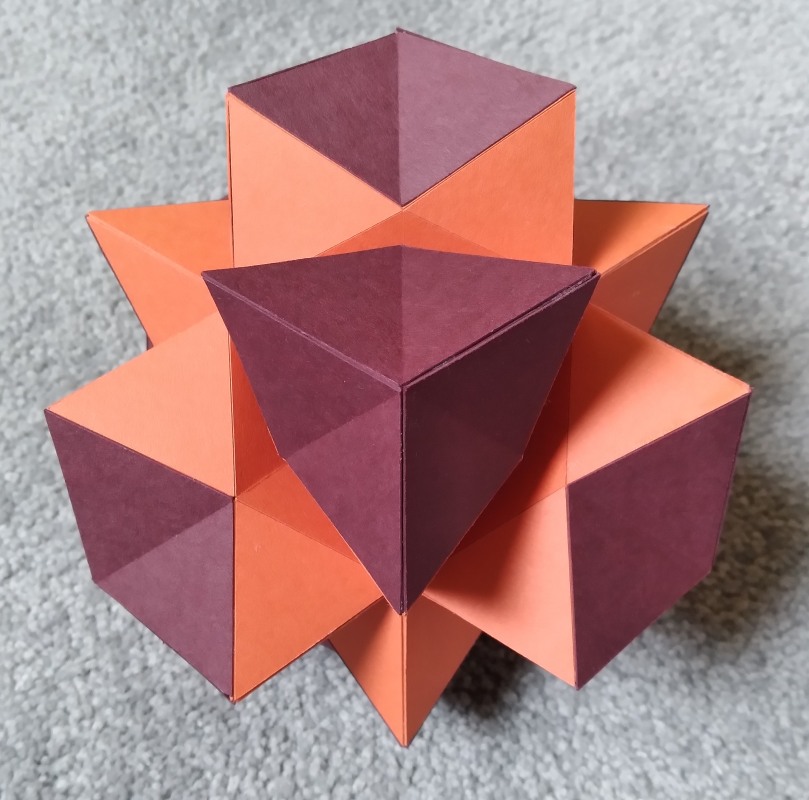
Don Romano has created a physical model of the level 2 triangulated triangular prism

Higher level triangulations


Triangulations at level 3 and above are possible in some cases (cube: level 3,
level 4, level 5) but the original triangulation of each seed polygon can no longer be performed with congruent triangles.  Other than the few examples listed, they have not been explored here.


Triangulated Rhombic and Hexagonal Polyhedra


The triangulation process can also be applied to the rhombic polyhedra and to the hexagonal faces of the duals to the triambic polyhedra.  Note that the level 1 results of the rhombics are the same as the level 2 triangulations of the Platonic / Kepler Poinsot polyehdra (up to isomorphism).  Shepherd [1] references are again supplied.

Seed
Level 1 Triangulation
Level 2 Triangulation
Rhombic Dodecahedron
(48,72,26) O2(2)
(96,144,50)
Rhombic Triacontahedron (120,180,62) I1(2)
(240,360,122)
Great Rhombic Triacontahedron (120,180,62) I3(1)
Degenerate
Medial Rhombic Triacontahedron (120,180,54) I2(2)
(240,360,114)
Rhombic Enneacontahedron (360,540,182)
(720,1080,362)
Great Triambic Icosahedron (dual of gidtid)
(60,90,32) I8(2) Note 3
(240,360,112)
Small Triambic Icosahedron (dual of sidtid) (120,180,52) I9(3)
Degenerate
Medial Triambic Icosahedron (dual of ditdid) (120,180,44) I5(2) (240,360,104)

Note 3:gidtid-  The relaxation of the triangulated dual results in a compound of two superimposed deltahedra.  Numbers, links amd references are to one part of the compound

Credits and Resources


The augmentation of the seed polyhedra, creation of the nets and initial relaxation was performed using Great Stella.   Stella VRML files were then converted into HEDRON input files using Roger Kaufman's VRML2OFF utility.  Then final relaxation and VRML generation using HEDRON

A zip file containing TXT and OFF files for all polyhedra on this page is here.


Thank-you to Don Romano for sharing his physical models.


References

1  Shephard G.C. (1999) Isohedral Deltahedra, Periodica Mathematica Hungarica Vol. 39 (1-3), 83-106

Back: to index